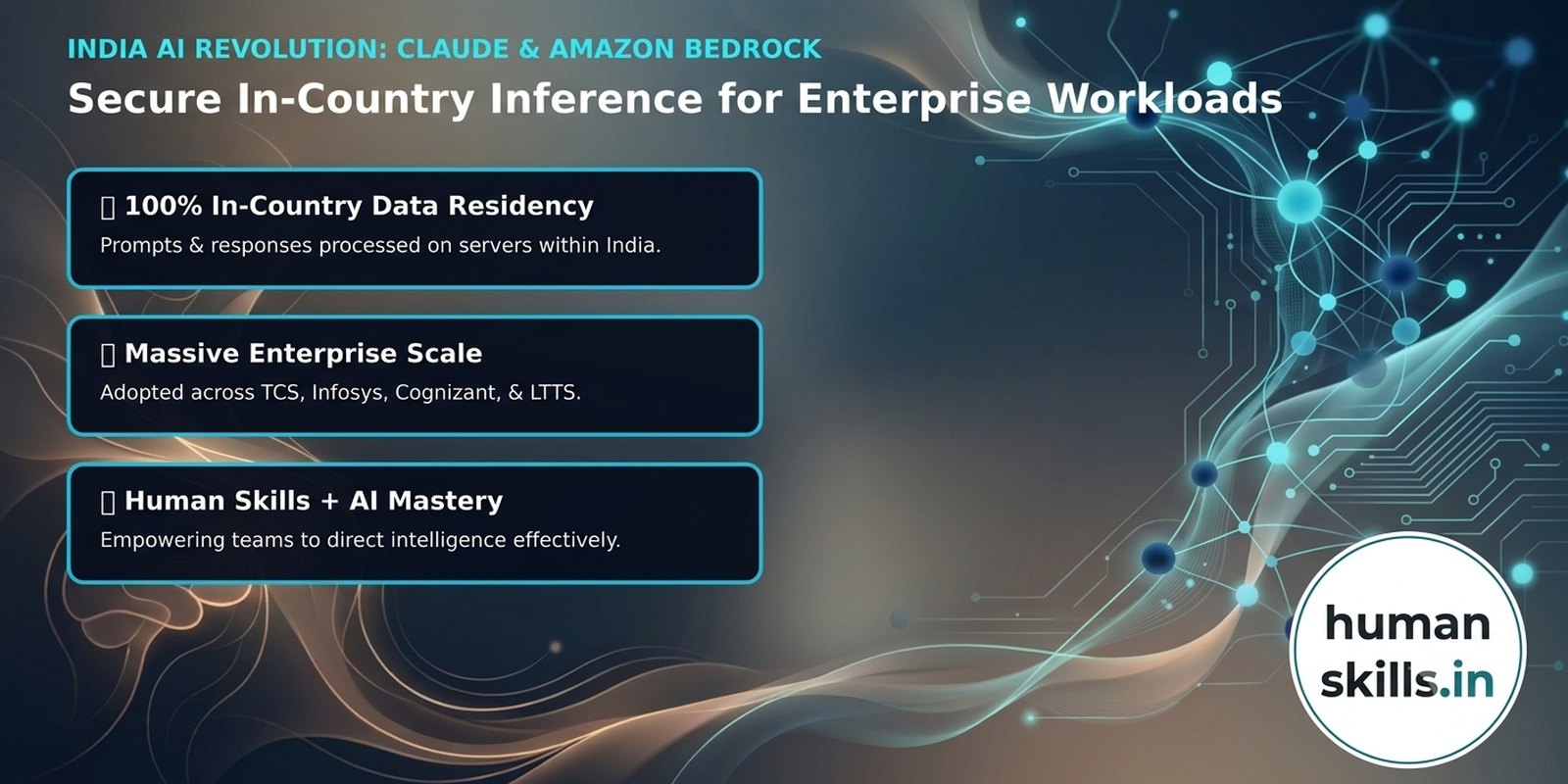
Data residency has been the single biggest barrier keeping India's regulated sectors from scaling generative AI. Banks, hospitals and public services could see the value, but could not send sensitive workloads to inference servers outside the country. That barrier has now moved.
Anthropic has brought in-country inference for its Claude models — including Opus 5, Sonnet 5 and Haiku 4.5 — to India through AWS Bedrock. When Indian customers use the local endpoint, both prompts and responses are processed entirely on servers located within India.
For banking, financial services, healthcare and public services, that satisfies the strictest regulatory mandates almost immediately. It is a genuine shift, and it removes an objection that has stalled a lot of enterprise AI programmes at the planning stage.
What the rollout tells us
- Total local data residency. Sensitive enterprise workloads can now stay inside India end to end.
- Surging momentum. India is now Anthropic's second-largest market globally, with software development driving over 45% of local use cases.
- Industry scale. TCS, Infosys, Cognizant and LTTS are embedding Claude across enterprise workflows.
The part that infrastructure does not solve
Here is the distinction worth holding on to. Local infrastructure removes the regulatory roadblock. It does nothing about the capability one.
Technology scales capacity. Human skills drive strategy, judgement and innovation.
A team with in-country access to a frontier model is not automatically a team that can use it well. The tool is now compliant and available. Whether it produces better decisions depends on whether the people directing it can frame a problem, question an output, and know when to overrule it.
That is the gap most organisations are sitting in right now: the infrastructure is ready before the people are. Closing it is a training problem, not a procurement one.
What I would do next
If your organisation has just cleared the data-residency hurdle, the useful question is not "which model?" but "who is going to direct it, and are they equipped to?" Start with the teams whose judgement carries the most consequence — quality, clinical, financial — and build capability there first.