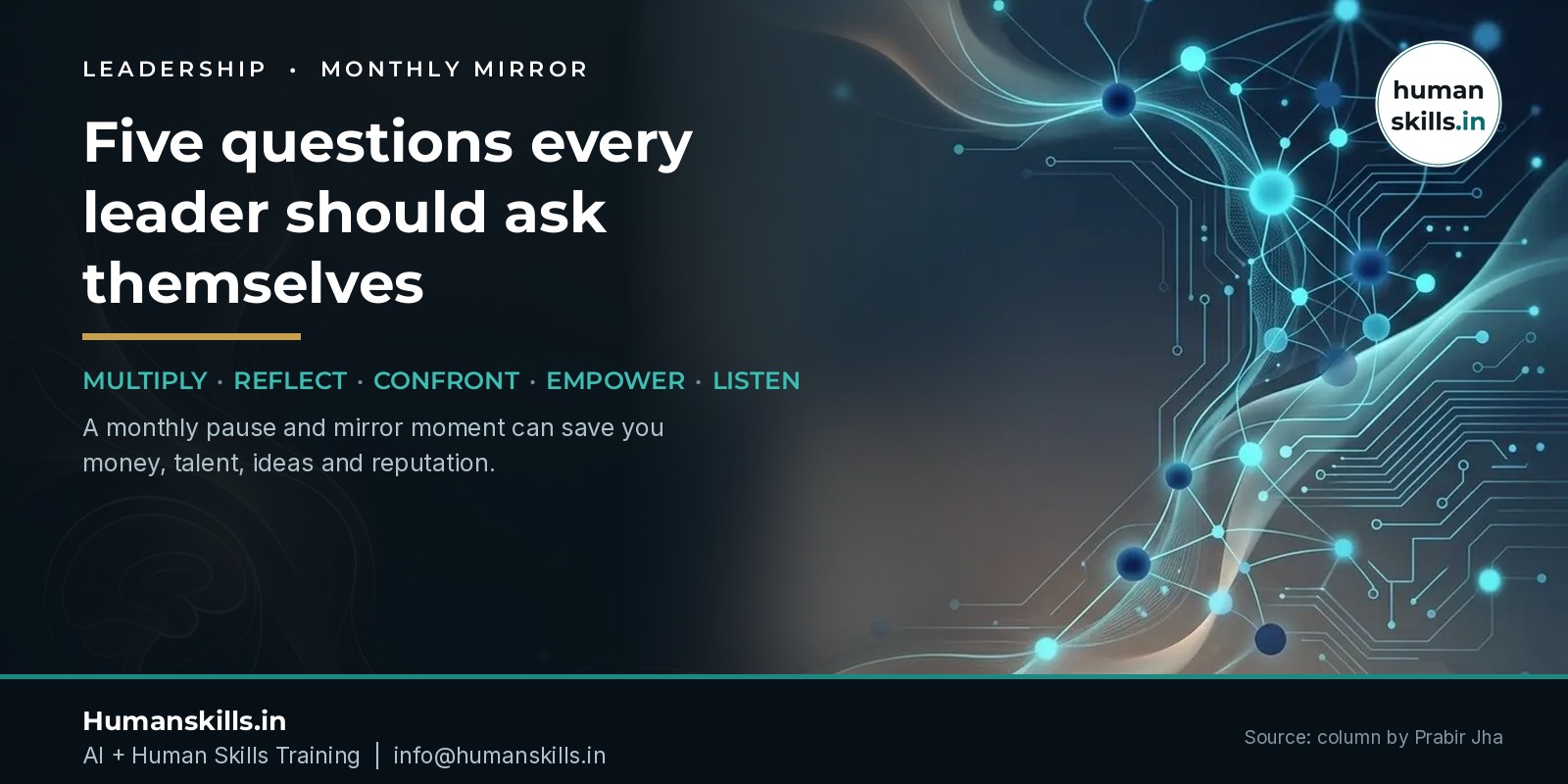
Most leaders review the numbers every month. They review timelines, business performance, delivery against plan. What almost none of them review is themselves. 🪞
They never pause to ask how they did as a leader.
That is an unfortunate rut, and an expensive one. Ask the question honestly and several downstream outcomes - retention, engagement, the speed at which decisions actually get made - tend to improve. Not in a burst, but sustainably, month after month.
Prabir Jha, founder and CEO of Prabir Jha People Advisory, sets out five questions every manager should ask themselves. They are sharp, deliberately uncomfortable, and worth an hour of your month.
1. The multiply question: did you make people better this month? 🌱
Or did you merely get a task accomplished?
You may be ensuring consistent delivery. That makes you a high performer - not necessarily a great leader. Your own brilliance has a boundary; leadership is about expanding the organisation's capability beyond your own.
Every interaction, every delegation, every decision should leave your people stronger than they were before it. If the work moved and the people did not, you delivered an outcome and spent an asset.
2. The reflect question: what did you learn about yourself? 🔍
Leaders assume they already know themselves. They usually do not, or not accurately.
This is not about work. It is about leadership behaviour: impatience, defensiveness when criticised, listening that is really just waiting for your turn to speak. Unless you consciously pause and reflect, your leadership gets stunted - you keep repeating the same three moves for a decade and call it experience.
Growth only happens in self-awareness. That is the uncomfortable part.
3. The confront question: what conversations did you avoid? ⏳
Which difficult conversation did you postpone this month? Which one did you duck entirely?
Procrastination is a natural human tendency, and seniority does not inoculate you against it. Executives lose focus, postpone tough decisions and find convincing reasons for the delay. What looks like careful consideration is often avoidance wearing a suit.
The best leaders face the question straight on. They do not have fewer uncomfortable conversations; they have them sooner.
4. The empower question: did you make the institution more or less dependent on you? 🏗️
There is ego underneath this question. Existentialism, fear, the need for control, the comfort of being the one who decides.
Leaders routinely involve themselves in decisions that should no longer require their attention. Instead of building teams and systems that function without them, they make themselves indispensable to routine matters - and become the very bottleneck they were hired to remove.
You do not need to be in the room for everything. You need the room to work without you.
5. The listen question: what are your people afraid to tell you? 👂
What anonymous feedback would you be most afraid to hear?
This question is deliberately uncomfortable. It shifts the ground from what you think your leadership is like to how people actually experience it - two things that are rarely the same.
Confronting that gap can be brutal. Leadership demands exactly that: the courage to invite criticism, the maturity to hear it without defensiveness, and the conviction to turn reflection into action.
Your leadership is not what you think it is. It is not about how you performed and delivered. It is how others experienced your leadership.
How to actually run the monthly mirror moment 🗓️
Knowing the five questions is easy. Sitting with them is not. Three things make the difference:
- 🗓️ Put it in the calendar. One hour, last Friday of the month, recurring. A question you intend to ask is a question you will not ask.
- ✍️ Write the answers, do not think them. Two lines per question, in a document nobody else reads. The act of writing is what stops you producing the answer you would like to be true.
- ✅ Leave with one action. Not five. One conversation you have been avoiding, or one decision you have been deferring, booked before you close the document.
Why this is a human-skills problem, not a tools problem
Here is the part I would add, from the training room. 💡
None of these five questions can be answered by a dashboard. Your analytics will tell you whether delivery slipped; they will not tell you whether the room relaxes when you walk into it, or which conversation your best performer has stopped raising because nothing happened the last three times.
The uncomfortable answers are the ones that come from people, not platforms. Which is why the managers who improve fastest are rarely the ones with the best tooling - they are the ones who built the habit of asking, and then had the nerve to act on what they heard.
If you are preparing managers for a bigger role, the training page sets out the managerial and human-skills sessions I run, and the free resources page has the prompt library and AI-readiness checklist that go with them.
A monthly pause worth taking
A monthly pause and mirror moment can save you money, talent, ideas and reputation - the four things that are hardest to rebuild once they walk out of the building.
Which of the five would be hardest for you to answer honestly? For most of the leaders I work with, it is the fifth.
If you would like to run this as a facilitated session with your managers, or build it into a leadership development programme, write to info@humanskills.in and I will share formats, outcomes and a proposal built for your context.
The five questions are drawn from a column by Prabir Jha, founder and CEO of Prabir Jha People Advisory. The notes on running the monthly review, and the human-skills framing, are my own.
If this is the problem your team is sitting in
Questions are a leadership tool. I run sessions that build the habit of asking them well. Corporate Training in Delhi NCR — half-day and full-day formats, on-site across Delhi NCR and India, or online.
Ask me about running it for your team or email training@humanskills.in