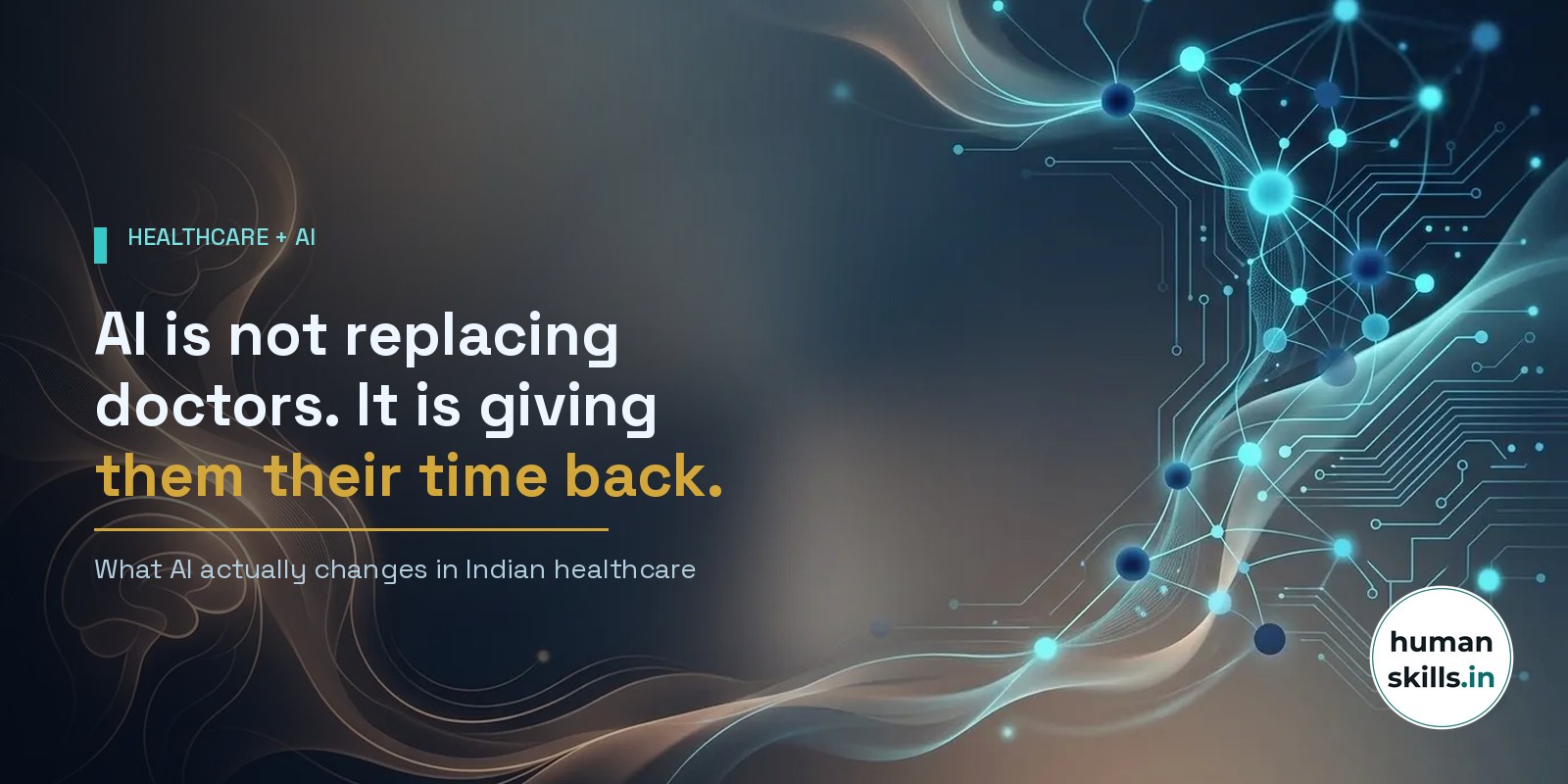
Is AI coming for healthcare jobs? The fear is understandable, but it misreads the problem India actually has.
The sector is not overstaffed. It is understaffed, badly. McKinsey has projected a global shortfall of close to 10 million healthcare workers by 2030. When you are short of people, the useful question is not "which jobs can a machine take?" It is "which hours can a machine give back?"
That is the shift worth understanding. AI in Indian healthcare is not arriving as a replacement. It is arriving as an augmentation - and the difference matters most to the people doing the work.
Four places it is already showing up
The administrative burden. Indian doctors report saving two to three hours a day by letting AI handle routine paperwork, scheduling and documentation. Two hours a day is a clinic's worth of patients seen. It is the least glamorous use of AI in medicine and probably the most valuable.
Diagnostics. Models trained on large datasets have reported accuracy above 95% in identifying several diseases from scans, with reporting times falling sharply. The point is not that the model outperforms a radiologist. It is that a first read arrives in minutes rather than days, and the specialist spends their attention on the difficult cases.
The rural gap. Paired with telemedicine, AI brings specialist-level diagnostic support into villages that have never had a specialist. This is where the arithmetic changes most: not better care for people who already had it, but first access for people who never did.
Economic weight. AI adoption in Indian healthcare has been projected to contribute up to $30 billion to the country's GDP. Capacity released from administration and faster diagnosis is not just a clinical gain - it is an economic one.
Where the machine stops
Here is the part that no model changes.
Machines are excellent at data, repetition and pattern recognition. They will get faster and cheaper at all three, indefinitely.
They cannot sit with a frightened family and explain what the scan means. They cannot build the trust that makes a patient tell you the thing they were too embarrassed to mention - the symptom that turns out to be the diagnosis. They cannot make the final call when the evidence points one way and the patient in front of them suggests another.
That is not sentimentality. It is a description of where the work actually is.
Humans working with machines
The future of medicine is not humans against machines. It is humans working with them - and the practitioners who learn to direct these tools now will be the ones leading in five years.
The doctors who resist AI will not be replaced by AI. They will be outcompeted by colleagues who use it, and who therefore have two more hours a day for the work only a person can do.
In medicine, technology may assist. Humanity will lead.