Every story that has ever moved you runs on the same skeleton. 🦴
And every presentation that has ever bored you is missing one of its bones.
The epics you grew up with, the film that made you cry, the case study a trainer told last month that you still remember — different worlds, same machinery underneath. Once you can see the machinery, you stop hoping a story will work and start building one that does.
This is not about being a "good storyteller". It is about understanding that a story is a structure, and structures can be learned.
🧩 The five ingredients of a story
Think of these as the raw material. Miss one, and the story limps.
1. The hero 👤
The role the story is carried on — the one we follow, worry about and root for.
A hero is not necessarily a person. It can be a man, a woman, a transgender person, an animal, a character, a group of people, a group of animals, a nation, or even an element.
- A river fighting for its own flow. 🌊
- A ward nurse who wants fewer infections and has no authority to change the process.
- A mother of two studying for an exam after a full shift.
The test is simple: can we follow them, and can we want something for them?
2. The quest 🎯
The mission the hero is on. What are they actually trying to do?
Solve a problem. Find something. Meet someone. Accomplish something. The best quests carry weight beyond the hero — a positive, lasting impact on people, the environment, science, or simply on how a thing is done.
- A village trying to get its river recognised as a living entity.
- A trainer trying to make forty sceptical managers care about feedback.
- A founder trying to get a product to market before the money runs out.
A quest is not a to-do list. It is the reason the hero gets out of bed.
3. The objectives ⚡
If the quest is the destination, the objective is the fuel. This ingredient answers one question: what is the impetus?
Why now? Why this? Why can't the hero walk away?
- The deadline nobody in the room is allowed to move.
- The resignation letter already sitting in a drawer.
- The one person who believed in the hero, now watching to see if they were right.
A quest without a clear objective is a hobby. An objective turns it into something urgent — and urgency is what makes an audience lean in.
4. The auxiliaries 🤝
The hero's support system, and the most under-used ingredient in stories told at work.
It can be family, a society, a group, a mentor, a teacher, a guide. It can also be intangible — knowledge, wisdom, emotional strength, physical strength, a skill learned years ago and half forgotten.
- The mentor who took a chance on someone unqualified.
- Notes from a course attended five years ago, still in a drawer, suddenly useful.
- The stubbornness inherited from a parent who never once said "give up".
Auxiliaries are why a hero is believable. A hero with no support is not brave; they are simply alone. 💛
5. The adversary 🐉
The character or force standing in the way — the main issue the hero is working to remove.
It can be a person. An animal. A situation. A problem. And very often it is the hero's own emotional weakness or skill gap — the hardest adversary to write honestly, and the one audiences recognise fastest.
- The manager who has decided you are a threat.
- A regulation that makes no sense and cannot be argued with.
- The hero's own impatience, or the skill gap nobody in the room wants to name.
No adversary, no story. A hero with nothing to push against has nothing to reveal.
🎬 The three parts of a story
Ingredients are what the story is made of. These three parts are how it moves.
1. The initial situation
The problematic situation the hero is working to remove. This is where you establish the world, the gap, and why it cannot be ignored.
- A team where the best performer has stopped raising problems.
- A plant that has never missed a dispatch date and is about to.
Get this wrong and nothing that follows lands, because the audience has no reason to care.
2. The course of action
The strategies the hero undertakes. Plan A, Plan B, Plan C.
- The pilot that works in one shift and fails in the next.
- The escalation that solves the problem and costs a relationship.
This is the middle — where most stories sag and most presenters rush. The value of this part is that it shows effort, adjustment and cost. A hero who succeeds on the first attempt has not been tested; they have been lucky.
And this is usually the part a corporate story skips entirely. One idea in slide four, problem resolved by slide nine, everyone in the room nodding politely and believing none of it.
3. The outcome
The results achieved after the hero has worked through those strategies.
And here is the point worth pausing on. 🛑
✨ The outcome does not have to be a solution
The outcome need not be the solution to the problem. It can be the learning the story reflects.
This is where the intellectual part of storytelling lives. A story that ends with "and so the problem was fixed" closes the door. A story that ends with "and this is what we understood" opens one.
Some of the most useful stories in a training room end in discomfort — the plan failed, the team learned what they were not willing to say to each other, the manager finally saw the pattern. It is the same instinct behind the five questions every leader should ask themselves: the value is in what the story makes you notice, not in the ending being tidy. The problem is still there, but the people in the room have changed, and that is the outcome that matters.
It also happens to be the honest ending. The hero who solves everything in the third act, usually with a slide deck and no budget approval, is the reason people stop believing case studies. 🎭
🏑 The whole skeleton, on one story
Take Chak De! India. If you have seen it, check the framework against your own memory of it — that is the test of whether a structure is real or invented.
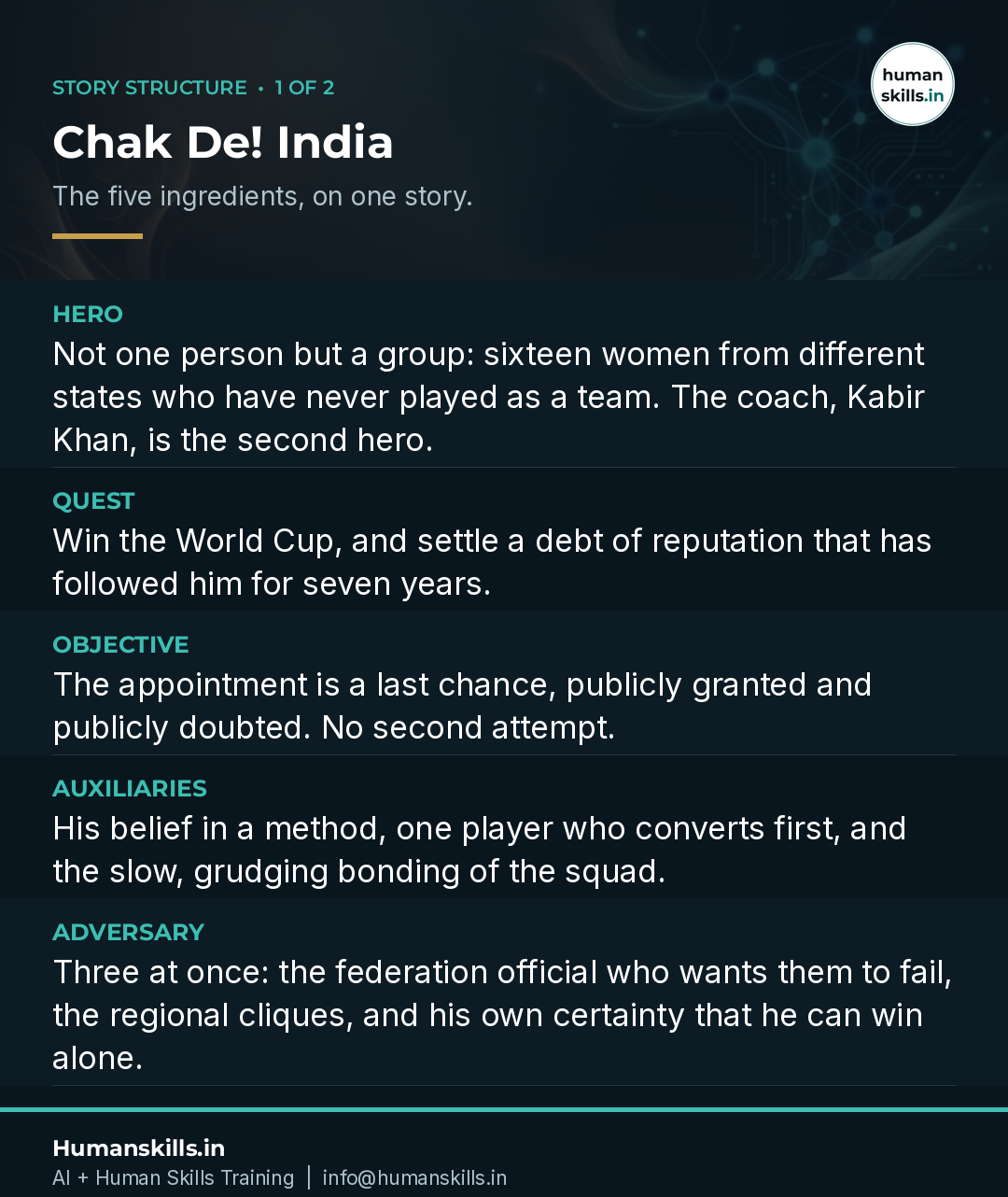
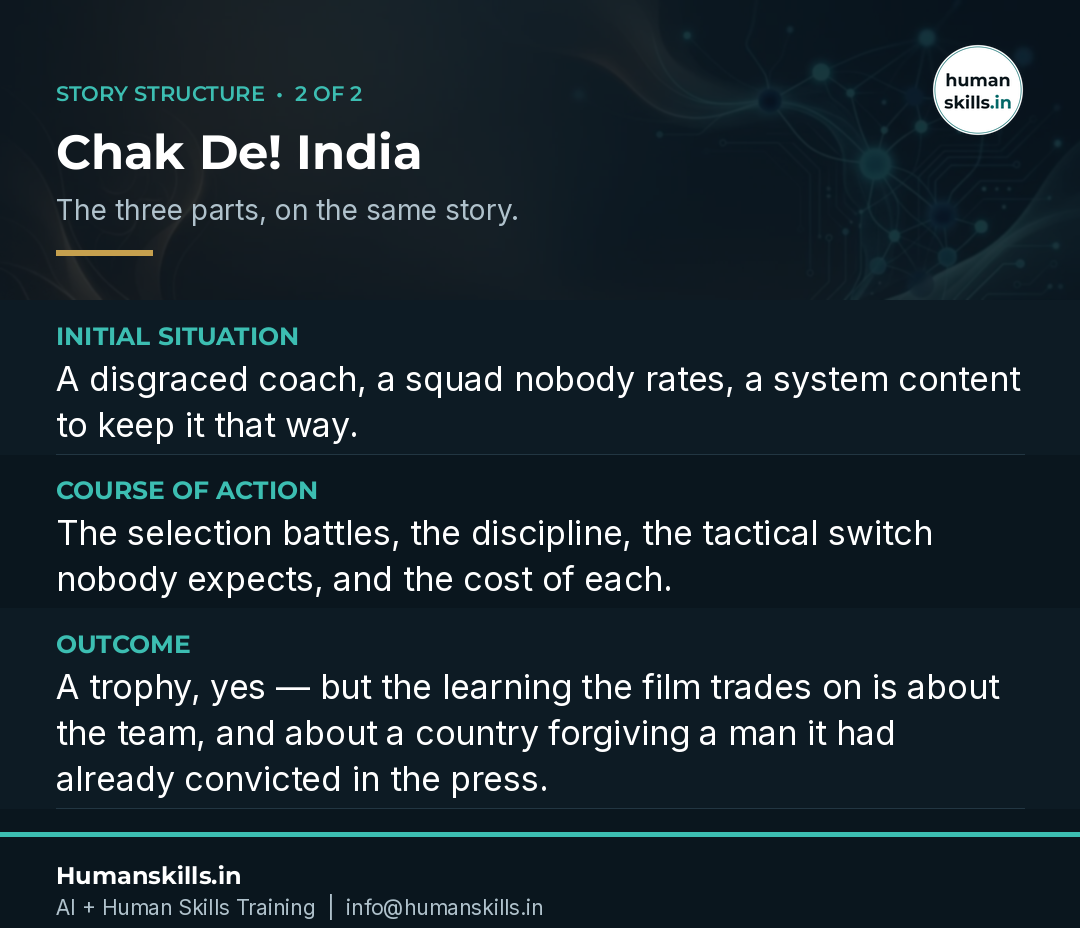
Notice what the adversary does there. Remove the internal cliques and you have a sports film about hockey. Keep them, and you have a story about belonging.
🧠 Why structure works at all
If the parts feel mechanical, it is worth knowing why they hold attention.
We are pattern-completers. Give an audience a hero and an adversary, and they will start predicting — will she make it, will he hold his nerve — and they stay because they want to know whether they were right. That is the engine, and it runs on unresolved tension.
An adversary creates stakes. Stakes create attention. Auxiliaries create hope, which is what stops the tension becoming merely bleak.
And a tidy ending relieves the tension — which is exactly why "and so the problem was solved" is satisfying in the moment and forgettable by the following week. An open ending leaves the thinking running after the room has emptied. 🧠
Structure is also a courtesy. It tells the audience where they are: this is the beginning, we are in the middle, this will close. A reader who knows where they are can relax and follow. A reader who does not is quietly working out whether to leave.
🛠️ What this looks like in practice
Once you know the skeleton, three things get easier.
You diagnose faster. When a case study falls flat, you can usually point at the missing ingredient — a hero nobody cares about, a quest with no objective, or an adversary so vague it cannot be argued with.
You write with intent. Instead of starting with what happened, you start with whose story it is and what they were up against. The incidents then arrange themselves.
You can teach it. Structure is the one part of storytelling that can be handed to someone else. I run this with managers in the soft skills sessions and with leadership groups in the corporate training programmes. Ask a manager to tell you about their team, and you will usually get a list of events. Ask them who the hero was and what the adversary turned out to be, and the list becomes a story. 💡
Storytelling is often described as a soft skill. It is closer to a craft: learn the parts, practise the assembly, and the instinct follows.
If you would like this run as a session for your team — narrative structure, case-study design and how to present so people remember it — write to info@humanskills.in. I run it with managers, trainers and L&D teams across Delhi NCR and India.
Which story shaped how you think? Tell me who the hero was — and what the adversary turned out to be.
About the author
Sudeep Ghosh is a corporate trainer based in Rohtak, Haryana, who works with corporate teams across Delhi NCR and India on AI, Six Sigma and human skills. Human Skills by Sudeep Ghosh runs programmes in soft skills, leadership, employability and mindfulness. The corporate training page sets out every programme with its formats and outcomes, and Client's testimonials shows what client teams have said after the sessions.