Human Skills by Sudeep Ghosh | +91 76987 09916 | हिंदी | info@humanskills.in | training@humanskills.in
Programme

Patient Experience Training for Hospitals and Healthcare Teams

Most patient-experience training ends with a feedback form. Staff are told to be more empathetic, the session closes, and three months later the complaint pattern is unchanged. This programme pairs how staff treat patients with the process measurement behind it, so a unit can see whether the behaviour actually changed.

Track A · the behaviour

Frontline practice

Every scenario is built from your own complaint log rather than a stock syllabus, and each session ends with an observable behaviour rather than a topic covered.

01
Respectful interaction
How staff speak to patients and families when the queue is long and the answer is unwelcome.
02
Complaint handling and recovery
Resolving at the desk instead of passing it upward, and apologising without admitting fault.
03
Difficult conversations
Angry and anxious patients and families: de-escalation, boundaries, and knowing when to stop talking.
04
Managing emotional load on shift
Self-regulation before the next patient, and a recovery routine after a difficult interaction that fits a real shift pattern.

Track B · the process

Measurement

The half of patient experience that is a process problem wearing a behaviour costume.

01
Mapping the patient journey
Entry to exit as patients experience it, not as the SOP describes it, with the handoffs and queues marked.
02
Defect and delay analysis
Separating delay, rework and repeat contact, and ranking complaint categories by volume.
03
Root cause on repeat complaints
Why the same complaint recurs, and testing a cause rather than assuming one.
04
Adherence checks and a metric set
A one-page weekly check a supervisor can actually run, and two or three indicators the team will keep.

How it is measured

Diagnose · Train · Measure

The part most training skips: proof that something changed.

01
Diagnose
The complaint log for the last six months, and a walk through the patient journey with the team. What recurs in the data decides which behaviour sessions get the most time.
02
Train
Behaviour is practised, not described. Every role-play is built on a scenario the team has actually lived through, with structured feedback after each attempt.
03
Measure
Two or three indicators agreed before the session, baselined in week one, and reported against at six to eight weeks. The report says what moved and what did not.

The indicators are chosen at the scoping call from data you already hold — complaint resolution time, repeat complaints in a named category, front-desk wait, or patient feedback on one specific touchpoint. What the report will not do is claim that a training session caused a change the data cannot separate from seasonal variation or a staffing change.

Who it is for

Audience

Frontline teams, and the supervisors who hold the standard after the session ends.

Front desk and reception, billing and insurance counters, nursing and ward staff, patient-care attendants, housekeeping and security — together with the supervisors and unit heads who coach them. Cohorts of 15 to 30. A group of 31 to 60 is run as two full-day batches rather than one large room, because the practice work needs groups small enough for everyone to rehearse and be observed.

Format and certification

Delivery

Delivered by me, on-site or online.

A full training day of six hours of contact time per batch. Participants register in advance through a link I provide, so you have the attendance list before the session; feedback is collected digitally at the end of the day; and every participant receives a verifiable digital certificate with a unique certificate ID and QR code, which stands up in a training record. Delivered on-site across Delhi NCR and pan-India, or online.
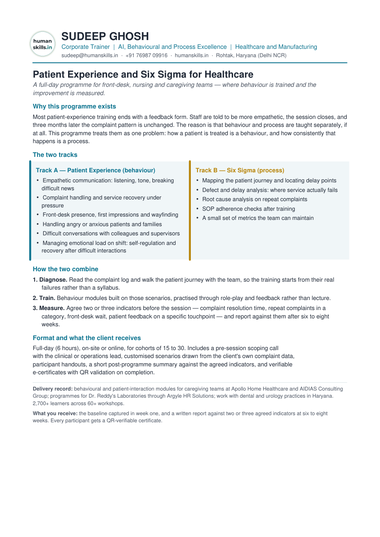
Patient experience programme one-pager

Take the one-page summary

Both tracks, the delivery format and the measurement approach on a single page — the version I would send you after an enquiry. No form, no email address needed.

Download the one-pager (PDF)

What a client said

Reference

“Your support, professionalism, and commitment have been truly commendable. The knowledge and insights shared by you have been extremely helpful and inspiring. Your engaging approach and clarity have made a meaningful impact.”

Dr. Sachin Mittal · Founder & Chief Dental Surgeon · Dr. Sachin Mittal Advanced Dentistry · February 2026

More letters, including healthcare and community work, are on the proof page.

Why this trainer

Background

Nineteen years in industry, eleven of them on a plant floor.

I spent eleven years in plant operations at UltraTech Cement and Shree Cement before moving into training, so the sessions are built for people who work standing up rather than for a conference room. Since 2018 I have run 60+ workshops for 2,700+ learners. Healthcare work includes behavioural and patient-interaction modules for caregiving staff at Apollo Home Healthcare and AIDIAS Consulting Group, alongside programmes for Dr. Reddy’s Laboratories delivered through Argyle HR Solutions, and work with dental and urology practices.

Questions

FAQ

The things hospital buyers ask most.

15 to 30 per batch. A group of 31 to 60 is run as two full-day batches, and the two days need not be consecutive.
I quote after a short conversation rather than publishing a rate card, because the same programme costs different amounts. The fee depends on how much is written for your team, group size, whether it is one day or a series, and the location. Tell me those four and you will have a written quote the same day.
In the job-relevant sense, yes. The fourth Track A session covers managing emotional load on shift — self-regulation before the next patient, and a recovery routine after a difficult interaction. It is built as a work behaviour rather than a meditation or mindfulness programme, and it is not offered as one.
No. The programme starts from your own complaint and feedback data, not from a syllabus, and it is written for mixed rooms of senior and junior staff. Non-clinical and clinical staff can attend the same batch.
A six-month extract of the complaint log, or a summary by category; the names and rough numbers for each batch; and one point of contact for logistics. Nothing else is required before the day.
Want this programme for your team?Get in touch →or email training@humanskills.in
Other programmes:Soft skills for teamsCorporate training overviewSix Sigma + AICritical Thinking with AIEmployability skills for colleges
Human Skills by Sudeep Ghosh
Human Skills by Sudeep GhoshTrainer · Coach
All Sections
01 Overview 02 Mission 03 Training Topics 04 Certificate 05 Photo Gallery 06 Press & Media 07 Testimonials 08 Experience 09 Credentials 10 Training & Dev 11 FAQ NEW 12 Connect 13 Sigma Tools NEW 14 Prompt Library NEW 15 Programmes & Fees
Patient experience for hospitals Corporate training (Delhi NCR) Soft skills for teams Six Sigma + AI Critical Thinking with AI Employability for colleges Mindfulness & Meditation
Available for Training
Try the tools: Six Sigma Calculators & Prompt Library Six Sigma Tools Prompt Library